
An epidemic survey of recent years has reached a conclusion that virtually 17.9 million lives are lost annually due to disorders of the cardiovascular system and that these are the biggest killers worldwide. The power to predict cardiac defects early may have potential to decrease morbidity and provide the opportunity for timely therapeutic interventions. This study proposes an integrated computational model that incorporates traditional pattern recognition methods with neural networks using a hierarchical approach to model aggregation, with transparent mechanisms of decision attribution. Specifically, the proposed system combines a multi-layered feed-forward neural network (NN) with batch normalization and dropout layers with nine different classification algorithms--Logistic Regression, Decision Tree, Random Forest, Gradient Boosting Tree, Support Vector Machine, KNN, XGBoost, LightGBM, and CatBoost--and benchmarked them on various datasets. The best-performing models were then integrated using a hierarchical stacking model: a Logistic Regression supermodel decides whether the test sets shall be combined or not, and which members of the stacking set should indeed be in the final model. Evaluated on the Cleveland cardiac dataset on UCI repository, the proposed model can achieve 90.16% classification accuracy, 96.43% sensitivity, and receiver operating characteristic of area under the curve 0.9524 with 303 clinical records in 13 physiology attributes. Oversampling with SMOTE helps to overcome the natural class imbalance found in the training partition, and Shapley-value-based attribution provides for each patient a fine-grained reason for each prognosis prediction. The Streamlit front-end application provides a fully functional web application to help with a fast bedside risk assessment. Empirical results show that the composite model architecture consistently outperforms individual classifiers by using the minimal possible rate of overlooked positive diagnosis (one), which proves to be very critical in clinical screening situations where negative diagnosis if overlooked has life-threatening consequences.

With the growing density of the population, traffic congestion, and changing conditions of disasters...
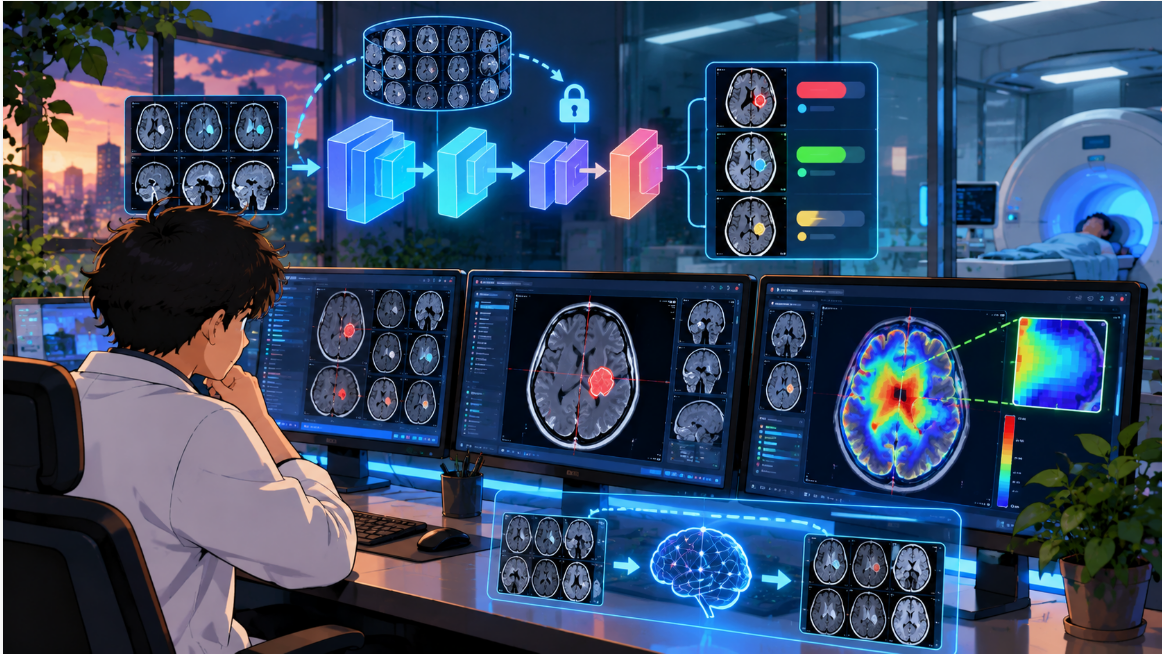
Brain tumours are among the most deadly cancers and require timely and accurate diagnosis to decide ...

Despite the dynamic nature of the market, large dimensionalities of asset space and varieties of fin...

Although the performance of LLMs on a wide variety of natural language processing problems demonstra...