

 Copyright & Plagiarism Policy
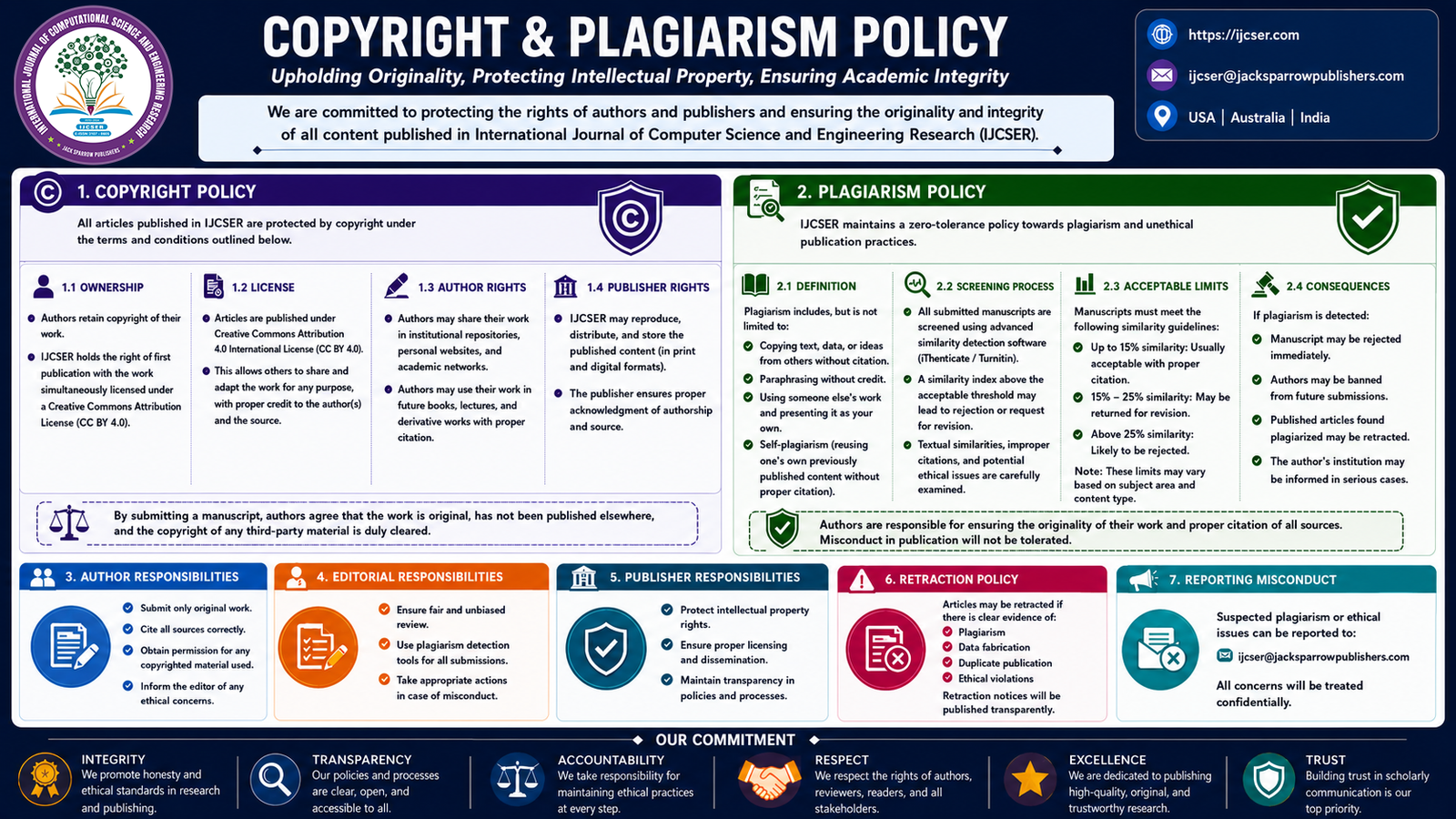
The International Journal of Computational Science and Engineering Research , e-ISSN: 3107 - 8605 is a multidisciplinary Double-Blind Peer-Reviewed Research Open Access Journal maintaining academic , research honesty and integrity is of utmost importance. We are committed to publishing original research and expect all submitted manuscripts to be the authors' own intellectual contributions. Plagiarism, in any form, is strictly prohibited and considered a serious breach of publication ethics.
Plagiarism includes, but is not limited to Copying text, ideas, images, or data from another source without proper citation. Reproducing large portions of one’s own previously published work (self-plagiarism) without appropriate referencing. Submitting work that closely resembles another author’s work, even if paraphrased, without acknowledgment.Using AI-generated content or translation tools without transparency or appropriate review and verification.
All sources must be properly cited, and quotations must be clearly marked. Even when information is paraphrased, the original author must be credited.
Generative AI Policy
The International Journal of Computational Science and Engineering Research , e-ISSN: 3107 - 8605 published by Jack Sparrow Publishers, we are committed to maintaining the highest standards of integrity, originality, and transparency in scholarly publishing. As part of our adherence to Scopus indexing evaluation standards and global ethical publishing practices, we have implemented clear Generative Artificial Intelligence (AI) Policies for authors, reviewers, and editors.
Use of Generative AI Tools
IJCSER recognizes that Generative AI technologies (such as ChatGPT, Copilot, Gemini, and similar tools) can assist in research development, data analysis, and manuscript preparation. However, their use must be responsible, transparent, and compliant* with ethical publishing norms.
Authors must disclose the use of any Generative AI tools in the Acknowledgment or Methods section of their manuscript, specifying the purpose and extent of use (e.g., language editing, idea generation, or coding assistance).
Generative AI tools cannot be listed as co-authors, as they do not meet authorship criteria defined by the COPE (Committee on Publication Ethics) and Scopus, Web of Science Indexing standards. The intellectual responsibility for the content, interpretation, accuracy, and originality of the manuscript remains entirely with the human authors.
Prohibited Use
Submitting AI-generated content without disclosure or misrepresenting AI-generated text, images, or data as original human work constitutes academic misconduct and may result in manuscript rejection or retraction. AI tools should not be used to fabricate data, citations, or experimental results.
IJCSER employs plagiarism detection and AI-content screening tools to ensure all submissions comply with our ethical and publication integrity standards. Editors and reviewers are trained to identify and evaluate the appropriate use of AI-generated content within submitted manuscripts.
Commitment to Transparency and Ethics
Through these policies, IJCSER aims to promote responsible innovation and uphold research quality aligned with Scopus indexing criteria, COPE guidelines, , Clarivate Academia & Research Genarative AI Policy , and global best practices in scholarly publishing. We encourage authors to use AI tools as a means of enhancement not replacement of human creativity and critical thinking.
Unacceptable Use of Generative AI
The following uses of Generative AI are " Strictly Prohibited " :
Data fabrication or falsification : Creating synthetic results, experiments, or references. Undisclosed AI-generated writing or images presented as original work. AI-generated citations or references that are unverifiable. AI-assisted peer review reports submitted without human oversight. Listing AI tools or systems as co-authors, as they lack accountability, consent, and the ability to take intellectual responsibility. Violation of these guidelines constitutes academic and Research misconduct and may result in: Immediate Rejection of the manuscript, Retraction of published articles, and Notification to authors’ affiliated institutions.
Peer Review Procedures
The IJCSER editorial board and Strict Double-Blinded Peer Review policy employs a combination of human oversight and digital tools to ensure ethical compliance, including:
Plagiarism detection systems (e.g., Turnitin, iThenticate). AI-content screening tools to identify machine-generated text or images.Verification of author disclosure statements related to AI use. Reviewer training to detect inconsistencies or overreliance on AI in submitted manuscripts. Editors and reviewers may request additional clarifications or source verification, if AI involvement is suspected or unclear.
Authors must disclose AI use and remain accountable for all content integrity. Reviewers should avoid using AI tools to generate review reports without authorization and must maintain the confidentiality of the manuscript. Editors must ensure fair assessment, adherence to strictly follow COPE and Scopus ethical standards, and prevent bias in editorial decisions involving AI-assisted manuscripts.
Compliance and Ethical Oversight
IJRDES’s Generative AI policy is guided by:
COPE (Committee on Publication Ethics) guidelines on AI use in research., Scopus’s Ethical Publishing and Content Policy Framework. and Elsevier’s AI Authorship Guidelines (2023) , Clarivate Academia & Research Genarative AI Policy and International Academic Integrity Standards.
Copyright Ownership
Authors submitting manuscripts to the International Journal of Computational Science and Engineering Research (IJCSER) must ensure that the work is original and not under consideration elsewhere. The copyright of the published article will remain with the authors unless the authors transfer it to the publisher.
Upon acceptance of the manuscript, authors may be asked to sign a copyright transfer agreement. The transfer agreement grants the publisher exclusive rights to publish and distribute the article in various formats, including electronic and print.
Originality of Work
The submitted manuscript must be original work by the author(s) and should not have been previously published in any form, including in other journals, books, or online platforms. Authors must ensure that the manuscript is free from plagiarism, self-plagiarism, and any form of academic dishonesty.
Plagiarism
Plagiarism is defined as the act of using someone else's ideas, writings, or research findings without proper attribution, and it is strictly prohibited.
All manuscripts will be checked for plagiarism through plagiarism detection software before acceptance. Any work found to have a high level of similarity to existing publications may be rejected or returned for revision.
Authors must provide appropriate citations and references for all materials used, including figures, tables, or data extracted from other works.
Self-Plagiarism
Self-plagiarism refers to the reuse of portions of one's own previously published works without proper citation. Authors must disclose any overlap between the submitted manuscript and their previous publications. In cases of significant overlap, proper citation is required.
Citation and Acknowledgments
Authors must properly cite all sources, including previously published work, data sets, or any material derived from other authors. In cases where authors used assistance from other researchers, funding agencies, or research facilities, proper acknowledgment should be given in the acknowledgments section.
Citation Ethics and Citation Manipulation Policy
International Journal of Computational Science and Engineering Research (IJCSER) is committed to maintaining responsible, transparent, and ethically sound citation practices consistent with accepted standards of scholarly publishing. Citations must be included solely because they are relevant to the research, provide appropriate scholarly context, acknowledge previous contributions, or support the scientific arguments presented in the manuscript.
IJCSER strictly prohibits any form of inappropriate citation manipulation. Authors, editors, reviewers, and editorial board members must not request, encourage, or require unnecessary citations for the purpose of increasing citation counts, journal metrics, author profiles, institutional visibility, or indexing performance.
Journal Self-Citation is permitted only when previous IJCSER publications are genuinely relevant and necessary to the scholarly context of the submitted work. Authors will never be required to cite IJCSER publications without legitimate academic justification.
Editor and Reviewer Self-Citation must also be based solely on scholarly relevance. Editors and reviewers must not request citations to their own publications merely to increase personal citation indicators. Reviewers shall disclose potential conflicts of interest and avoid inappropriate citation recommendations.
The journal prohibits coercive citation, citation stacking, reciprocal citation arrangements, excessive or irrelevant self-citation, citation cartels, and institutional citation manipulation.Editorial decisions shall never depend upon the number of references to IJCSER, its editors, reviewers, authors, or affiliated institutions.
To strengthen editorial independence, manuscripts submitted by authors affiliated with an editor's institution, research group, or close collaborators shall be handled by an independent editor whenever a potential conflict of interest exists. The concerned editor shall not participate in reviewer selection, editorial recommendation, revision decisions, or final acceptance decisions.
The Editorial Board will periodically review citation patterns, including journal self-citation, editor-related citations, institutional concentration, and unusual citation relationships. Where potentially inappropriate citation practices are identified, the journal may request clarification, remove unjustified references, investigate the matter, reject a manuscript, or take appropriate editorial action.
IJCSER is committed to developing its citation impact organically through high-quality research, international scholarly collaboration, rigorous peer review, improved research visibility, and meaningful scientific contributions. Citation metrics will not be treated as a substitute for research quality, originality, methodological rigor, or scholarly significance. Through this policy, IJCSER affirms its commitment to editorial integrity, responsible citation, transparency, academic independence, and ethical research communication and will continuously review and strengthen these practices as part of its commitment to internationally recognized standards of scholarly publishing.
Retraction and Corrections
In cases where plagiarism or copyright infringement is identified after publication, the International Journal of Computational Science and Engineering Research (IJCSER) reserves the right to retract the article. Authors may also be required to provide an explanation regarding the issue.
Corrections or clarifications may be published if errors are identified in the published article.
Ethical Considerations
Authors must adhere to ethical standards of research, including avoiding fraudulent data and ensuring the integrity of the research process. Any conflicts of interest should be disclosed at the time of submission.
Licensing
Articles published in the [Journal Name] may be made available under an open-access model or with subscription access. Authors will be informed of the licensing options and may choose the most appropriate one for their work. Authors will be granted a non-exclusive license to reuse their article under specific conditions.
Author Responsibilities
Authors are responsible for ensuring that their manuscripts comply with the journal’s copyright and plagiarism policies. The corresponding author must ensure that all co-authors have read and approved the manuscript and are in agreement with its submission. By submitting a manuscript to the International Journal of Computational Science and Engineering Research (IJCSER), authors confirm that they have read and understood this Copyright and Plagiarism Policy and agree to comply with its guidelines.
 News Board
 Cover Page



 Manuscript Status