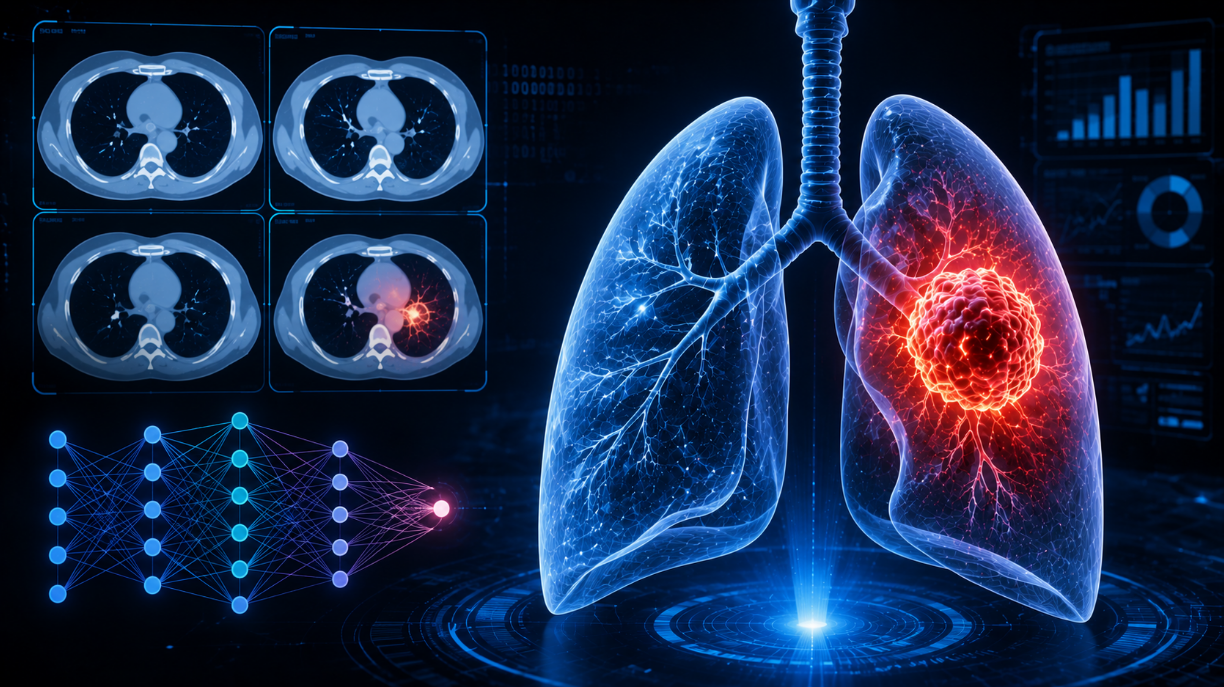
Lung cancer remained one of the leading causes of cancer-related mortality worldwide, making early diagnosis essential for improving treatment opportunities and patient outcomes. Computed tomography (CT) imaging became an important diagnostic modality because of its ability to capture detailed anatomical information from the pulmonary region. At the same time, advances in artificial intelligence and deep learning created opportunities for automated medical image analysis and decision support. Despite this progress, challenges, including limited labelled datasets, moderate generalisation capability, computational constraints, reproducibility concerns, and limited interpretability, continued to influence the development of reliable diagnostic frameworks. This research developed a transfer learning framework based on ResNet50 for lung cancer detection using CT scan images, evaluated classification performance through accuracy, precision, recall, and F1-score, and established a reproducible experimental baseline for future explainable and optimised diagnostic systems. A publicly available CT image dataset containing four diagnostic categories was utilised. Data preparation included image resizing, normalisation, and augmentation before model training. The experimental outcomes demonstrated progressive learning behaviour throughout training, where training accuracy reached 71.32% and validation accuracy reached 62.50%, accompanied by decreasing training and validation loss values. Evaluation on the testing dataset produced an overall classification accuracy of 57%, with weighted precision, recall, and F1-score values of 0.57, 0.57, and 0.50, respectively. Class-level analysis indicated stronger recognition performance for normal CT images and comparatively balanced detection capability for adenocarcinoma, whereas lower performance was observed for large cell carcinoma and squamous cell carcinoma. The findings suggested that transfer learning remained a practical approach for CT-based lung cancer classification under limited data conditions. In addition to experimental evaluation, the study contributed a reproducible implementation framework that may support future comparison, explainability integration, and continued optimisation of diagnostic models.
Keywords : Lung Cancer Detection, CT , ResNet50, Transfer Learning, DL, Medical Image Classification.
Authors : J.V. G. Prakasa Rao Pyla , Dr. D. Mabuni
Title : Lung Cancer Detection from CT Images Using ResNet50
Volume/Issue : 2026;3(3 (July - September))
Page No : 10 - 20

 ISSUE: Volume 3 (2026) , Issue 3 (July - September)







 Cover Page




 Manuscript Status